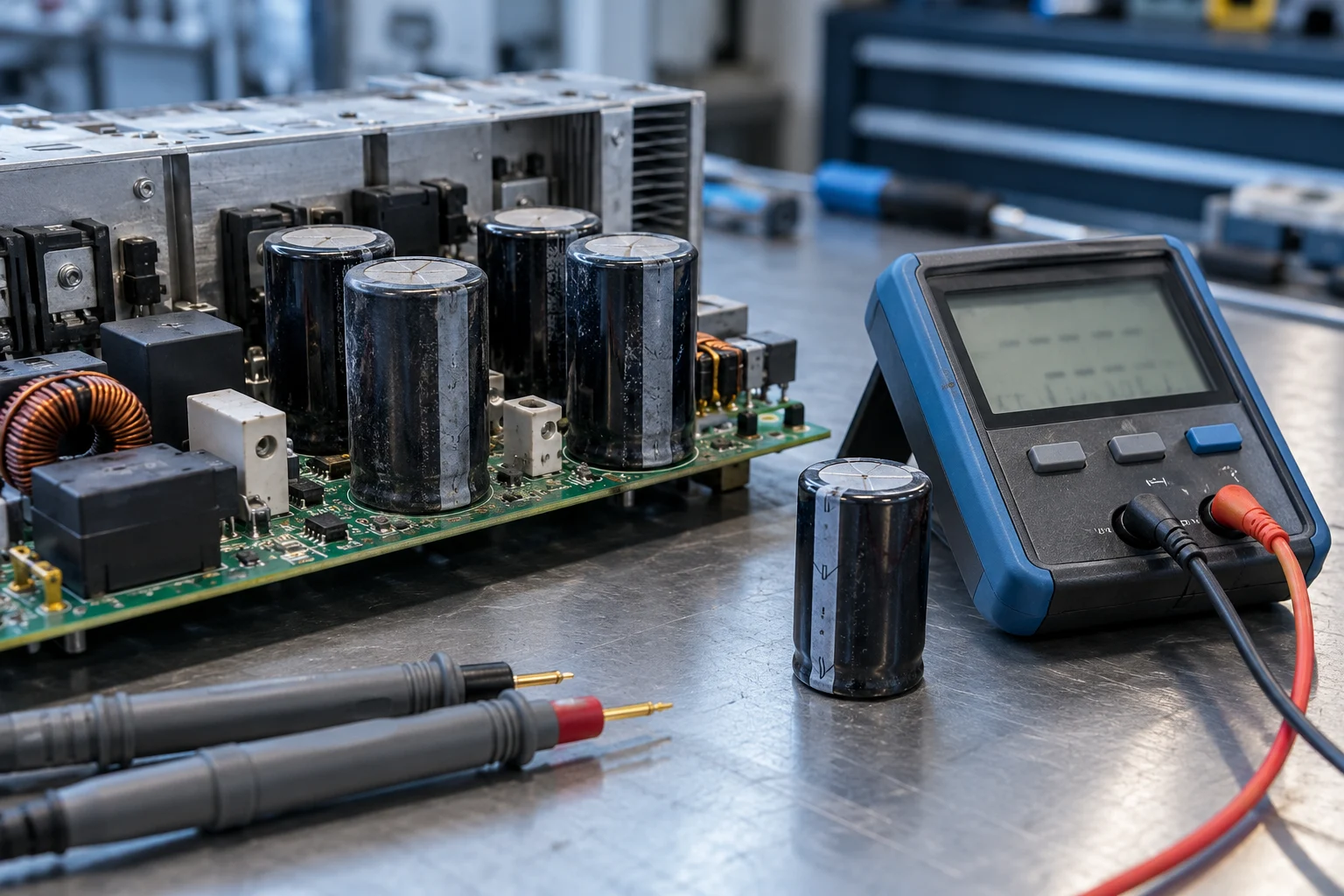
Electrolytic capacitor ageing does not always show itself through a bulging case. Slow start-up when the device is cold, resets under load, increasing ripple or temperature-dependent behaviour may be observed. These symptoms do not by themselves prove a capacitor failure, but a sound inspection plan should assess ESR, ripple current and thermal conditions as well as capacitance.
01Can there be a problem even when the capacitance looks normal?
Equivalent series resistance, or ESR, is part of a capacitor's lossy behaviour. An increase in ESR can increase heating under ripple current and affect the circuit's response to transient loads. Therefore, simply seeing a measurement close to the nominal capacitance does not mean that overall performance has been maintained.
The measurement frequency and temperature affect the result. An in-circuit measurement can also be affected by parallel components. Results should be compared against the data for the part series used and appropriate measurement conditions. There is no single “anything above this ESR is faulty” limit that applies to every device.
02Temperature and ripple current act together
The air temperature around a capacitor and its internal temperature may not be the same. Ripple current produces losses across the ESR. A simplified loss calculation can be expressed as P ≈ I² × ESR; a real assessment uses the frequency components and the manufacturer's model.
For example, assuming the same ESR, doubling the ripple current quadruples the loss in this simple model. This shows why a higher current is not only an electrical problem but also a thermal one. It should be remembered that, in a real part, ESR varies with temperature and frequency.
03Do not read a lifetime calculation as a guarantee
Some aluminium electrolytic series use approximate temperature-dependent lifetime models. However, “exactly double the lifetime for every 10 °C reduction” is not an unconditional rule for all technologies and conditions. The ranges, ripple corrections and estimation limits given by the manufacturer for the relevant series should be followed.
Equally, the hours figure in a catalogue is not, on its own, the device's service life. It only has meaning together with the specified test temperature, applied voltage and ripple conditions. An estimate for a part running cooler should not be used as an unlimited extension that ignores the seal, environmental conditions and other ageing mechanisms.
| Selection/diagnosis area | Characteristic to check |
|---|---|
| Electrical | Capacitance tolerance, ESR/impedance, voltage |
| Ripple | RMS current and frequency coefficients |
| Heat | Ambient conditions, nearby heat sources and airflow |
| Mechanical | Size, lead spacing, vibration and mounting |
| Application | Frequent power cycling, storage and load cycling |
04An equivalent part is not just µF and volts
A part with the same capacitance and a higher voltage rating is not automatically a suitable equivalent. ESR, ripple current rating, temperature class, lifetime series, size and application conditions must be compared. The stability of some regulators depends on the characteristics of the output capacitor; switching to a very different ESR can change the behaviour of the design.
Why the part being replaced was under stress is also examined. If a clogged fan, rising ambient temperature or another faulty component persists, the new part will be exposed to the same conditions. Saying “the capacitors have been replaced” is no substitute for root cause analysis.
05The inspection must be safe and measurable
Drive and power supply capacitors can retain hazardous energy after power has been disconnected. Discharging and voltage verification are carried out by competent personnel in accordance with the device's service instructions. This article is not a procedure for measuring or replacing parts on an energised device.
During service, visual findings, the capacitance/ESR measurement conditions and the device's behaviour under load are recorded. Rather than blindly replacing every part in a batch, the extent of the damage and the application risk are assessed. After the change, ripple, start-up, load transient and temperature tests are repeated using an appropriate method.
06Which data should be kept for maintenance?
- The device's operating temperature and fan/filter condition.
- Whether the fault occurs at cold start or under load.
- Part series, measurement condition and replacement date.
- Comparative test result after replacement.
These records help assess, at the next maintenance, not only the age of a part but also why it wore out. The aim is not to blame every fault on a capacitor, but to examine thermal and electrical stress on the basis of evidence.
07Example verification scenario
Suppose a power supply is slow to start only from cold. Before replacing any part, the start-up time, ambient temperature and connected load are recorded. The capacitor is measured under suitable conditions and the old and new behaviour are compared. The device is then tested not only when warm but also from a cooled-down start. This test helps establish whether a symptom that disappears during normal operation has genuinely been eliminated. Without measurement findings, it is not claimed that the problem is definitely the capacitor.
Technical references and further reading
For product- and version-specific values, the relevant manufacturer's current documentation should be taken as the reference. The calculations and scenarios above are engineering examples for illustrative purposes.