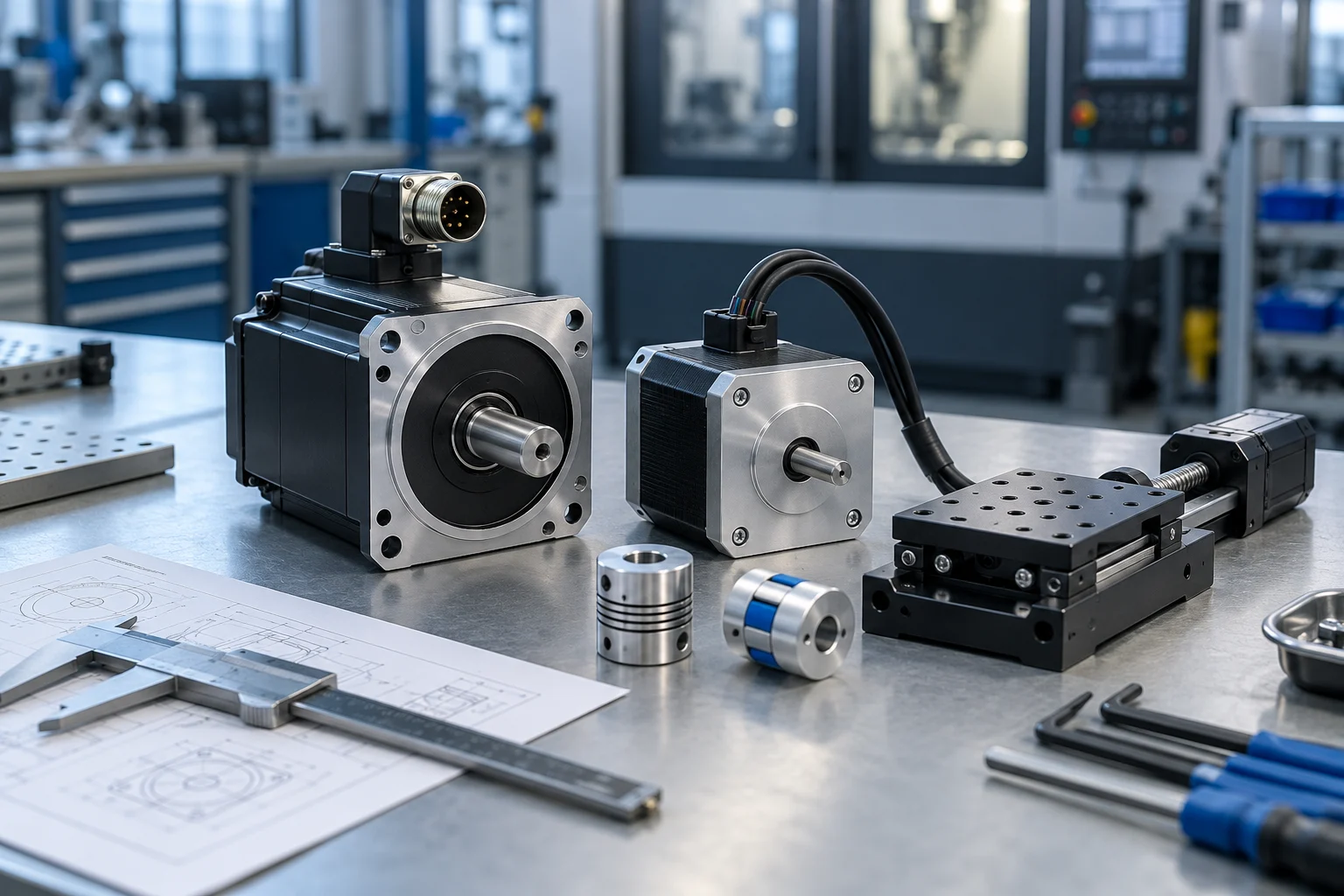
Choosing between a servo and a stepper cannot be reduced to price and precision alone. Assess travel distance, speed profile, load inertia, stopping accuracy and mechanical transmission together. In particular, assuming that accuracy increases in direct proportion to the microstep count can lead to misleading machine-design decisions.
01Define the motion task first
Define the axis travel in millimetres, the time allowed for that move and how often it repeats. Acceleration and deceleration times matter as much as cycle time. A horizontal transfer axis and a vertical load-holding axis also behave differently after loss of power.
Specify target positioning accuracy and repeatability separately. Consistently returning close to the same point does not prove the absolute position is correct. Backlash, screw error, deflection and temperature changes cause errors independently of motor resolution.
02Examine the torque-speed curve
A stepper can be a strong option at low speed, but its available torque may change substantially as speed increases. A servo's continuous and short-term torque regions must be assessed using its own curve and drive. Do not assume the motor's nameplate torque is available at every required speed.
Calculate friction, process force and acceleration torque together. A motor that holds the load while stationary may be insufficient during acceleration. A gearbox increases torque while also changing speed, backlash, efficiency and inertia relationships. Assess the motor-drive pair using manufacturer data.
03What does feedback guarantee?
Sending command pulses to an open-loop stepper system does not directly prove that the axis reached the intended position. Excessive load or unsuitable acceleration can cause lost steps. Closed-loop stepper solutions also exist, so the generalisation that steppers never use feedback is incorrect.
Encoder feedback in a servo system enables the tracking error to be monitored. However, the controller may not fully observe mechanical backlash located downstream of the encoder's measurement point. A motor encoder and a linear measurement system represent different information. The feedback location is part of the error budget.
| Criterion | Considerations for steppers | Considerations for servos |
|---|---|---|
| High speed | Available torque on the curve | Continuous / peak torque and speed limits |
| Short moves | Acceleration and resonance | Tuning and settling time |
| Position verification | Feedback requirements | The actual point measured by the encoder |
| Heating | Holding current and duty cycle | RMS torque and thermal load |
| Cost | Including mechanics and drive | Including commissioning and maintenance |
04Microstepping is not measurement accuracy
For example, an axis using a screw with a 5 mm lead, 200 full steps per revolution and 16 microsteps has a command increment of 5 / (200 × 16) = 0.0015625 mm. This is numerical command resolution. It does not establish that the axis actually has an absolute accuracy of approximately 1.6 micrometres.
Motor angular error under load, screw accuracy, bearings, couplings and structural deflection affect the overall result. Presenting catalogue resolution as product tolerance without distinguishing these factors creates problems during acceptance. Measure the required precision under actual load and temperature conditions.
05Vertical axes and loss of power
Loads that could fall after a power failure require mechanical holding, braking and a safety assessment. A motor's energised holding torque is not a solution for the de-energised condition. Determine whether a brake is suitable for static holding or dynamic stopping from the manufacturer's specification.
Plan homing, encoder absolute-position capabilities and restart procedures together. Specify which position the axis will accept after power returns and when motion will be permitted. Do not leave this decision solely to a drive parameter.
06Repeat the same cycle during acceptance testing
Test with the heaviest load, shortest cycle and conditions approaching the highest ambient temperature. Record motor/drive temperature, position error, vibration and settling at the end of the cycle. Assess long-term stability separately from a single fast move. The best system is not the most powerful motor regardless of need; it is one that performs the defined movement repeatably and can be maintained.
07Example verification scenario
Suppose an axis moves correctly without load but occasionally falls short when a product is fitted. Before changing command resolution, examine load torque, acceleration, mechanical friction and connections. Compare symptoms such as lost steps in a stepper or following error in a servo with recorded actual movement. An unloaded bench test should not be accepted before repeated cycles with the heaviest product are completed. Include warm-state position and settling time in the test scope.
Technical references and further reading
For product- and version-specific values, the relevant manufacturer's current documentation should be taken as the reference. The calculations and scenarios above are engineering examples for illustrative purposes.